Language & Words
How writing systems spread, and why they rarely arrive intact
Scripts move across languages far more readily than languages do, and every time one arrives somewhere new it has to be bent to fit sounds it was not designed for.
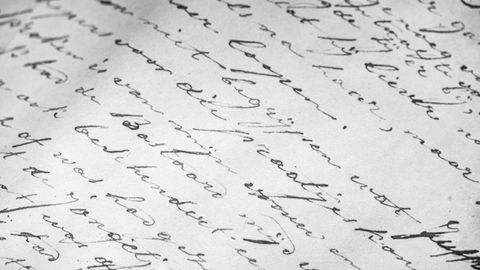
Writing has been invented from scratch a small number of times. The count depends on definitions and on some contested cases, but the number of clearly independent inventions is in the low single figures — Mesopotamia, China, Mesoamerica, and probably Egypt, with debate about whether the last was stimulated by contact.
Everything else is descent or borrowing. The scripts used across most of the world today trace back to a small number of ancestors, transmitted along trade routes, through religion, and by administration.
The great family
A very large share of the world's alphabets descend from one source: a system developed in the second millennium BCE by speakers of a Semitic language, apparently adapting Egyptian signs to write their own sounds.
From that root come the Phoenician script and, from it, Greek, Latin, Cyrillic, Hebrew, Arabic, and the Brahmic scripts of South and Southeast Asia — which means the letters on this page and the scripts used for Hindi, Thai, Tibetan and Khmer share a distant common ancestor.
The Chinese script took a different path, spreading to Japan, Korea and Vietnam and being adapted in each — most dramatically in Japan, where two syllabaries were derived from simplified Chinese characters and are used alongside them, and in Korea, where an entirely new and deliberately designed alphabet eventually replaced it.
The problem every borrowing faces
A script encodes the sounds of the language it developed for. Move it to a language with different sounds and something has to give.
The Semitic scripts wrote consonants and largely left vowels unmarked, which works reasonably for languages where the consonant skeleton carries the root meaning and vowels indicate grammar. Greek, with a different structure, took letters representing consonants it did not use and repurposed them as vowels — a change that is often described as the invention of the full alphabet.
Latin, adapted for languages across Europe, ran repeatedly into sounds it lacked letters for. The solutions have been various and inconsistent: new letters, digraphs, diacritics, or simply reusing an existing letter for a different sound.
This is why the same letter behaves so differently across European languages, and why the sound written one way in one language may be written three other ways in its neighbours.
The mismatch accumulates
Even when a script fits at the moment of adoption, languages change and spellings do not. Sound changes accumulate over centuries while the written form is anchored by literacy, printing and institutional inertia.
English is the standard example. Its spelling reflects, roughly, the pronunciation of several centuries ago, plus borrowings that kept their source spellings, plus some deliberate meddling by early printers and scholars. The result is a system where the relationship between letter and sound requires substantial memorisation.
Other languages have reformed. Several have undertaken spelling reforms bringing orthography closer to pronunciation; a few have changed script entirely, usually as part of a political project.
Script changes are almost never purely technical. Adopting or abandoning a script signals alignment — religious, political, national — and the debates around them are correspondingly heated.
Religion as the main vector
Historically, the most powerful driver of script spread has been religion, because sacred texts have to be readable.
The Arabic script spread with Islam across an enormous area, being adapted for Persian, Urdu, Malay, Hausa, Ottoman Turkish and many others, each time with added letters for sounds Arabic lacks. Brahmic scripts spread through Southeast Asia with Buddhism and Hinduism. The Latin alphabet travelled with Christianity, and Cyrillic was created explicitly to write Slavic languages for liturgical purposes.
Administration is the second vector: an empire's records require a script, and the script outlasts the empire.
What is lost when a script goes
When a language changes script, everything written in the old one becomes inaccessible to anyone without specialist training. That happens within a generation or two.
Twentieth-century script changes in several countries had exactly this effect: material from before the change — literature, personal letters, records — became unreadable to ordinary readers. Whether that was a cost worth paying is a question people in those places still argue about, and the answer generally tracks what they think of the political project that accompanied it.
The scripts being made now
New writing systems are still created, usually for languages that have been oral.
Some are adaptations of Latin, developed by linguists or missionaries. Some are entirely new designs made by community members, deliberately distinct from the scripts of neighbouring or dominant languages — a choice that is about identity as much as about phonology.
Whether a new script takes hold depends less on its design quality than on institutional support: whether it is taught in schools, whether anything is published in it, and whether it can be typed. That last constraint is more decisive than it sounds. A script without digital font and keyboard support is, in practice, a script that cannot be used, and getting a script encoded and supported is a slow bureaucratic process that has become one of the more consequential bottlenecks in language preservation.
Also by Lena Farkas
- Street food is a system, not a categoryFood Cultures
- Children who grow up with three languagesLanguage & Words
- Famine foods and the knowledge nobody wants to needFood Cultures
- Whistled and drummed languages: speech carried across a valleyLanguage & Words