Food Cultures
Street food is a system, not a category
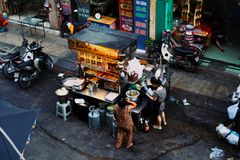
Cooked food sold in public space has existed as long as cities have, and it does specific work in a household economy that home cooking cannot.
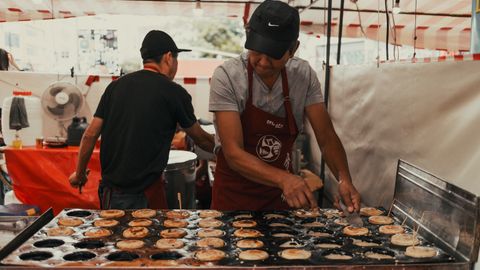
Food prepared and sold in public space appears wherever there are cities, and the reasons are consistent across enormously different places.
Why it exists
Fuel economics. Cooking at home requires fuel, and for most of urban history fuel was expensive and cooking facilities in cramped housing were limited or absent. Buying cooked food from someone with a fire going was frequently cheaper than lighting your own.
This is not a historical curiosity. In many cities today, households in small dwellings without adequate kitchens rely on prepared food for exactly the same reason.
Labour. Where all adults in a household work long hours outside the home, cooking is time that does not exist. Street food substitutes purchased labour for domestic labour, and it does so cheaply.
Scale. A vendor cooking one dish two hundred times a day does it more efficiently, with better equipment and less waste, than two hundred households each cooking once.
Location. Food where people are — at markets, transport hubs, workplaces, outside schools, at the point where a shift ends.
The specialisation
The defining feature of most street food traditions is extreme specialisation. A vendor makes one thing, or a very short list, and makes it repeatedly for years.
That produces a level of execution that a generalist kitchen cannot match, and it is why the best version of many dishes in many cities is sold from a cart by someone who has made nothing else since they were twenty.
It also produces a distributed cuisine, where a full meal is assembled from several vendors rather than produced by one kitchen — which is the normal arrangement in a number of food cultures and which visitors frequently misread as a lack of restaurants.
The economics for the vendor
Street vending has low barriers to entry, which is much of its social function.
It requires little capital, no premises, and skills that can be learned within a family. It is therefore one of the more accessible routes into self-employment for people with limited options — migrants, women with childcare responsibilities, people without formal education.
The corresponding facts are that margins are thin, hours are long, the work is physically hard, and there is generally no security of tenure, no insurance and no pension.
Vendor associations exist in many cities and have organised around exactly these issues, with varying degrees of recognition.
The regulatory conflict
Street vending is in permanent tension with municipal authority, and the pattern repeats across cities.
Authorities cite food safety, obstruction, hygiene, tax and public order. Vendors cite livelihood, the absence of alternatives, and the fact that the food is what a substantial part of the population eats.
Enforcement tends to be episodic and heavy — clearances, confiscations, relocations to purpose-built markets that are frequently in the wrong place and therefore fail.
The relocation problem is instructive. A vendor's position is their business; moving them a few hundred metres away from the footfall removes the customers. Purpose-built vendor markets that ignored this have stood empty in a number of cities while vending continued on the street outside.
Where regulation has worked better, it has generally involved licensing in place, providing water and waste facilities, and training rather than removal.
The food safety question, honestly
Risks are real: water quality, temperature control, hand washing, and the practicalities of running a food business without running water.
They are also frequently overstated relative to the alternative. A busy stall with high turnover, food cooked to order in front of the customer at high heat, and a vendor whose entire business depends on regulars not getting ill, has structural advantages over a kitchen nobody can see.
The practical guidance that experienced travellers converge on reflects this: eat where it is busy, where turnover is fast, where food is cooked in front of you, and where local people are eating.
Gentrification and the food hall
A recent pattern worth noting. Street food has become fashionable in wealthy cities, appearing in curated markets and food halls at prices far above what street food anywhere costs.
These are a different product — the aesthetic of street vending applied to a formal food business with rent, staff and licensing.
Nothing wrong with that in itself. What is worth noticing is when the fashion coexists with continued clearance of actual street vendors in the same city, which has happened in several places.
What it tells you about a city
The state of street food is a reasonably good indicator of several things: how much of the population works long hours away from home, how adequate housing is, how the authorities treat informal work, and how public space is used.
A city with abundant street food is generally a city where a lot of people are out in it, eating in public, at all hours. A city that has cleared it has usually made a decision about who its streets are for.
Also by Lena Farkas
- Children who grow up with three languagesLanguage & Words
- Famine foods and the knowledge nobody wants to needFood Cultures
- Whistled and drummed languages: speech carried across a valleyLanguage & Words
- Hands, sticks and bread: how food is actually carried to the mouthFood Cultures