Places
Islands make different rules
Isolation does specific things to language, biology and social organisation, and island communities across the world have arrived at similar solutions to similar constraints.
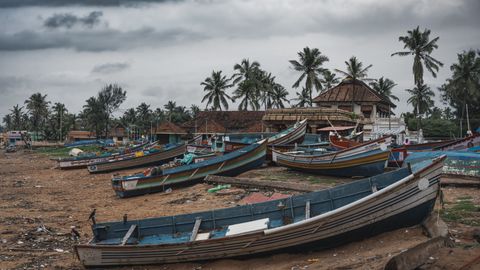
An island is a place with a hard boundary, a finite area and a limited population. Those three facts produce consistent effects wherever they occur.
Language does unusual things
Isolated speech communities diverge from their mainland relatives, and they do so faster with smaller populations and less contact.
Island dialects frequently preserve features that have disappeared elsewhere — conservative pronunciations, older vocabulary, grammatical forms that the mainland dropped. They also innovate, developing features that never existed elsewhere.
The Pacific offers the clearest large-scale example: the Austronesian expansion across an enormous ocean produced hundreds of related languages, each shaped by the population that settled a particular island group, with relationships between them that allow the sequence of settlement to be reconstructed.
Small islands also produce unusual linguistic phenomena. Several islands with high rates of inherited deafness developed community-wide sign languages used by hearing and deaf people alike, which is a genuinely different social arrangement from a signing minority within a hearing majority.
Biology follows its own rules
Island biogeography is a well-developed field, and the patterns are striking.
Species arriving on islands frequently change size — some lineages become much smaller than their mainland relatives, others much larger. Explanations involve resource limitation and the absence of predators, and the pattern is well documented in the fossil record.
Flightlessness evolves repeatedly in island birds where there are no ground predators, which is precisely why island bird populations have been so devastated by introduced rats, cats and dogs.
Islands also host disproportionate numbers of species found nowhere else, which makes them enormously important for biodiversity and enormously vulnerable. A large share of recorded extinctions in recent centuries have been island species.
Social organisation adapts to the boundary
A community that cannot expand and cannot easily leave develops mechanisms for managing what would otherwise be unmanageable.
Resource rules. Island communities frequently have detailed customary systems governing access to fishing grounds, land, timber and water. The commons problem is acute where the commons is visibly finite, and a substantial body of research has documented island and coastal communities managing shared resources successfully over long periods through local rules and enforcement.
Marine tenure systems across the Pacific, including seasonal closures placing an area off limits to allow stocks to recover, are among the better-documented examples of long-standing local resource management.
Conflict management. On a small island you cannot avoid the people you have fallen out with. Many island societies developed elaborate mechanisms for dispute resolution and formal reconciliation, because unresolved conflict in a closed community is corrosive in a way it is not in a city.
Marriage rules. Small populations face genuine constraints. Systems specifying who may marry whom, and traditions of exchange between islands, address a real demographic problem.
Navigation knowledge, where island groups are linked by sea. Pacific navigation traditions using stars, swell patterns, bird behaviour and cloud formations represent a body of practical knowledge that allowed voyaging across enormous distances, and their maintenance has been the subject of a substantial revival since the 1970s.
The economics are unforgiving
Everything imported costs more. Everything exported costs more to move. Economies of scale are unavailable. Specialised services — hospitals, universities, particular trades — require populations that small islands do not have.
The consequence across the world is outward migration, particularly of the young, and island populations that are ageing and shrinking.
What sustains the ones that persist tends to be specific: a fishery, tourism, a strategic position, a subsidy from a mainland government, or a diaspora sending money home. Remittance economies are a defining feature of many island states.
Tourism, which cuts both ways
For many islands it is the only substantial industry available. It brings income, employment and infrastructure.
It also brings pressure on water, waste systems and housing that were sized for a much smaller population, seasonal employment that does not sustain a year, and a tendency for property to shift toward holiday use, pricing out the people who live there.
Several island communities have introduced visitor caps, tourist taxes or restrictions on short-term letting. These are contested locally, since the people who depend on tourism and the people displaced by it are frequently different people.
Sea level
Low-lying islands face the most immediate consequences of rising seas, and the issues are not only inundation. Saltwater intrusion contaminates freshwater lenses, storm surges reach further, and coastal erosion accelerates.
Several island nations have raised these as questions of statehood and sovereignty at international level — what happens to a country's legal existence, its maritime zones and its citizens if the territory becomes uninhabitable. Those are unresolved questions in international law, and they are being asked by people for whom they are not hypothetical.
Also by Anahera Wetere
- What a heritage listing does to a placePlaces
- Lullabies are frequently not comfortingFolklore
- When one employer is the whole townPlaces
- The gift that has to be returnedFestivals & Ritual