Craft Traditions
Boats built without plans
Traditional boatbuilders work by eye and by proportion, producing hulls of considerable subtlety, and the knowledge is held in the shape of the shed rather than on paper.
A hull is a complicated three-dimensional shape whose form determines how a boat behaves in the water — how it carries load, how it handles a following sea, how much it will take before it becomes dangerous.
Traditional builders across the world produced these shapes without drawings, working from proportion, from moulds, and from an accumulated body of judgement that was transmitted by working alongside someone who had it.
Shell first and frame first
Two fundamental approaches, and the distinction runs through boatbuilding everywhere.
Shell-first construction builds the outer planking to shape and inserts internal framing afterwards to stiffen it. The shape is determined as the planking goes on, by the builder's eye and by the natural behaviour of the material.
Clinker construction — overlapping planks fastened to each other — is the classic shell-first method in northern Europe, and the boats built this way are light, flexible and forgiving.
Frame-first construction erects the internal structure and then covers it. The shape is decided in advance by the shape of the frames, which allows planning, standardisation and larger vessels.
The transition from shell-first to frame-first in various regions was a significant technological shift, and it corresponds to the point at which boatbuilding became something that could be specified rather than only performed.
Sewn boats
Planks stitched together with cord rather than fastened with metal, using coir, palm fibre or root, with the seams caulked.
Documented across the Indian Ocean, Southeast Asia, parts of the Mediterranean historically, and elsewhere. The construction is flexible, repairable at sea with materials available on any shore, and requires no metal, which mattered where metal was expensive.
Sewn vessels have made long ocean passages, and the technique is not a primitive precursor to nailed construction so much as a different solution with its own advantages.
Dugouts and expanded dugouts
The simplest form, and one of the most widespread — a log hollowed by cutting and burning.
The refinement that makes it more than simple is expansion: hollowing the log thin, then softening it with water and heat and forcing it wider with spreaders, which produces a hull considerably beamier than the original tree and with a shape that is genuinely designed.
Extended dugouts add planks to the sides of a hollowed base, which is the bridge between dugout and plank-built construction and is found in many traditions.
Skin and bark
Where large timber was unavailable, boats were built as a light framework covered with skin or bark.
Kayaks and umiaks across the Arctic use driftwood or bone frames covered in sewn sealskin, producing craft that are extraordinarily light, seaworthy and repairable. The kayak in particular is a highly refined design, fitted to its user and to specific hunting conditions, with regional variations that are functionally distinct.
Bark canoes across North America and elsewhere use birch or other bark over a wooden frame, sealed with resin. Light enough to be carried between waterways, which is exactly what the transport system required.
Hide boats of various kinds — round coracles, larger currachs — appear across Eurasia and are still built in some places.
Outriggers and the Pacific
The addition of one or two outrigger floats produces stability without weight, and it enabled the sailing canoes that carried the settlement of the Pacific.
Those vessels were capable of long ocean passages, and the associated navigation tradition — using stars, swell patterns, birds, and the behaviour of the sea around islands — allowed voyaging without instruments across enormous distances.
Both the building and the navigation traditions declined severely under colonial administration and have been the subject of a substantial and successful revival since the 1970s, with voyaging canoes built to traditional design making long passages navigated without instruments.
How the knowledge was held
In many yards, the shape was carried in physical templates — moulds and patterns used repeatedly — and in the builder's judgement about how much to deviate from them for a particular boat.
Half models, carved to shape and then measured, were used in several traditions as a way of designing in three dimensions before committing to full size.
A great deal was simply not recorded. Which means that when a yard closed and the last builder died, the specific local type frequently went with them, and reconstructions since have had to work from surviving hulls and from photographs.
The type is fitted to the place
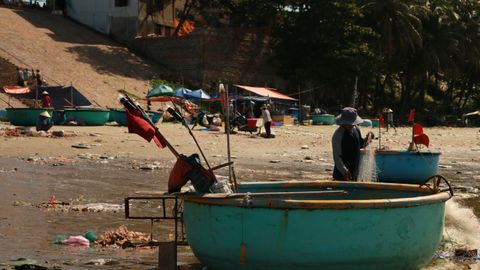
Local boat types are adapted to particular conditions with considerable precision: the state of the sea, whether the boat must be launched from a beach or lies at a mooring, what it carries, how it is propelled, how many crew.
A flat-bottomed boat for shallow estuaries, a deep keel for exposed coasts, a shape that will take the ground upright at low tide, a bow designed for launching through surf. Each of these is a response to a specific condition, and moving a type to another coast frequently produces a poor boat.
What survives
Working traditional boats persist where they still do a job better than an alternative, which is a shrinking category.
Beyond that, survival depends on heritage funding, on sailing associations, and on a market for traditionally built craft. Several countries maintain training programmes deliberately, on the reasoning that once the last builder retires the knowledge cannot be reconstructed from a hull alone.
The judgement about how a plank should lie, which cannot be written down, is the part that is genuinely at risk.
Also by Emeka Nwosu
- Mending as a visible actCraft Traditions
- Thatch, mud and stone: building with what is within reachCraft Traditions
- Making instruments: wood chosen for how it soundsCraft Traditions
- Embroidery that says where you are fromCraft Traditions