Craft Traditions
Embroidery that says where you are from
In many traditions, a stitched garment identified a village, a marital status and a family, and could be read by anyone who knew the vocabulary.
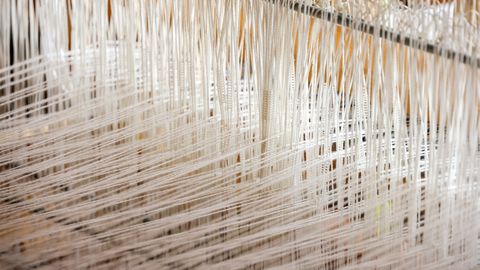
Decorated cloth is close to universal, and in many traditions the decoration is not decoration in the sense of being optional. It carries information.
Regional embroidery styles frequently encode: where the wearer is from, sometimes to village level; whether they are married; whether they have children; their age group; occasionally their family or clan.
The Palestinian embroidery tradition is a well-documented example, where regional motifs and colour schemes distinguished dress from different areas, and where a knowledgeable observer could place a woman's origin from her garment. Comparable systems have been documented across the Balkans, Central Asia, Central America, southern China and elsewhere.
Why the information was worth encoding
In societies where marriage was arranged between communities and where people met at markets and festivals, a garment that stated origin and marital status did substantial social work without requiring anyone to ask.
It also marked belonging. Wearing the correct pattern for one's community was an assertion of membership, and adopting another's could be a claim or an intrusion depending on the context.
The techniques
Counted-thread work, where stitches are placed by counting the threads of the ground fabric. Produces geometric patterns and requires an evenly woven base. Cross stitch is the most familiar form and there are many others.
Free embroidery, worked without counting, allowing curved and figurative designs.
Appliqué, where shapes of one fabric are stitched onto another, used heavily where thread was expensive or where bold pattern was wanted.
Whitework, white thread on white ground, with the pattern created through texture, drawn threads or cut spaces.
Metal thread work, using gold or silver-wrapped thread, generally reserved for ceremonial and elite garments because of cost.
Each region tends toward particular techniques, determined by available materials and by what the base cloth allowed.
Where the patterns come from
Motifs are frequently named, and the names are often of everyday things — plants, tools, animals, architectural features, stars. Whether the motif originally depicted the named thing or acquired the name later is usually impossible to determine.
Meanings attached to motifs should be treated with some caution. Published lists of symbolic meanings are frequently later reconstructions or the interpretation of a single informant generalised too widely. Ask ten embroiderers in one region and you will get a range of answers, several of which will be "that is just how it is done".
What is more reliably documented is the association of particular motif sets with particular places, and the rules about which patterns go on which garment and which part of it.
How it was learned
Almost always from female relatives, in childhood, by working alongside them. Girls in many traditions produced sampler pieces demonstrating the range of stitches and motifs, which functioned as both practice and record.
A substantial part of the skill is not stitching but layout — knowing where a pattern goes on a garment, how it is scaled, and how borders meet at corners. That knowledge sits between the maker and the tradition and it is what distinguishes a correct piece from a competent one.
The economics
Hand embroidery is extraordinarily labour intensive. A fully worked traditional dress can represent months of work, done in the intervals of other labour, often over years.
That investment made such garments valuable, inheritable and closely associated with the person who made or wore them. It also made them the first thing to go when cheaper alternatives appeared.
Machine embroidery and printed imitations of embroidered patterns have displaced hand work almost everywhere as everyday dress. What survives is ceremonial use, commercial production for craft markets, and revival driven by cultural identity.
Embroidery as political material
Because it marks identity, embroidery becomes political where identity is contested.
Traditional dress has been suppressed by states pursuing homogenisation, adopted as national costume by states constructing an identity, revived by communities asserting continuity, and appropriated by fashion in ways that range from acknowledged collaboration to straightforward copying of protected designs without credit or payment.
The copying question has become active. Several communities have pursued legal and commercial routes to protect designs, with mixed success, since intellectual property frameworks designed for individual authorship handle communal traditional designs badly.
Where it is being kept
Cooperatives producing for craft markets have sustained a good deal of hand embroidery, particularly where the income is meaningful relative to local alternatives.
Documentation projects have recorded stitches, motifs and garment construction in a number of regions, sometimes just in time.
And there is a genuine revival among younger people in several places, learning from grandmothers or from published records, frequently framed explicitly as reclaiming something. Whether the result is continuity or reconstruction depends on the case, and the makers involved are generally quite clear-eyed about which it is.
Also by Emeka Nwosu
- Mending as a visible actCraft Traditions
- Thatch, mud and stone: building with what is within reachCraft Traditions
- Boats built without plansCraft Traditions
- Making instruments: wood chosen for how it soundsCraft Traditions