Craft Traditions
Making instruments: wood chosen for how it sounds
Instrument makers select material by tapping it, and the traditions that developed around particular timbers, skins and metals are among the most conservative of any craft.
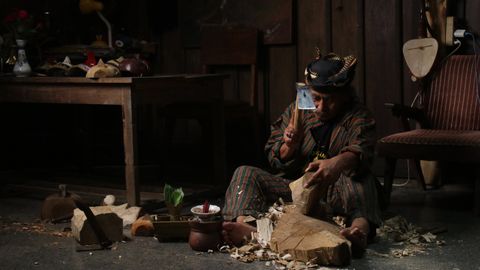
An instrument is a structure designed to vibrate in a controlled way. Every material choice, thickness and joint affects how it does that, and the relationships are complicated enough that instrument making has proceeded largely by accumulated empirical knowledge rather than by calculation.
Tapping
Makers across many traditions select and thin material by tapping it and listening.
A soundboard is worked down gradually, tapped repeatedly, until the maker judges it right. What they are listening for is difficult to articulate and it is consistent enough that experienced makers agree with each other.
The physical properties underlying this are measurable — stiffness along and across the grain, density, damping — and modern makers sometimes measure them. The traditional method reaches similar conclusions by ear, which is a good example of a craft procedure encoding physics without describing it.
The timbers
Softwoods with straight, even, tight grain are used for soundboards across an extraordinary range of traditions — spruce in Europe, related species elsewhere. The properties wanted are high stiffness relative to weight, which lets a thin plate be both strong and responsive.
Hardwoods are used for backs, sides, necks and fingerboards, chosen for stability, density and workability.
Several traditional tonewoods are now restricted or endangered, and international trade in some species is controlled. This has forced makers toward alternatives, and the results have been better than the traditionalist objection predicted — the properties that matter are found in more species than the tradition assumed.
Ageing matters. Wood for instruments is seasoned for years, and older material behaves differently as the internal structure changes. This is one area where the claims made are more confident than the evidence supports, and where a substantial amount of money changes hands on the basis of it.
Skin, gut and metal
Drum heads across most traditions were animal skin, prepared much like leather but not tanned — dehaired, scraped and dried under tension. Skin responds to humidity, which is why traditional drums need tuning and retuning constantly and why players in humid climates spend time warming heads over fires.
Synthetic heads removed that problem and changed the sound, and traditions differ on whether that trade is acceptable.
Strings were gut, silk, or metal depending on tradition and period. Gut strings sound different from steel and behave differently under changing humidity. Several early music traditions have returned to gut deliberately, having established that the instrument was designed around its properties.
Metal instruments involve their own metallurgy — the alloys used for bells, gongs and cymbals are specific, and in some traditions the composition and the working process are closely held.
The instruments that require a tree
Several traditions depend on particular species that take a long time to grow, which introduces a constraint on the craft that is genuinely different from other trades.
Where a maker requires a timber that takes a century to reach usable size, the craft depends on someone having planted or protected trees long before. Several instrument-making regions have historically had managed woodlands for this purpose, and where the management lapsed the supply eventually failed.
The same applies to large drums carved from single logs, to instruments requiring particular gourds, and to anything using materials from species now under pressure.
The conservatism
Instrument making tends to be unusually resistant to change, for a specific reason: musicians compare new instruments to remembered ones, and a maker who deviates risks producing something that is not accepted regardless of its quality.
Some traditions have essentially frozen their designs, reproducing forms established centuries ago. Others have continued to develop.
Blind listening tests comparing celebrated historic instruments with contemporary ones have produced results that unsettle a number of long-held assumptions, and the reaction to those studies has been informative about how much of the field's belief rests on evidence.
The apprenticeship
Instrument making is one of the crafts where apprenticeship has survived most robustly, partly because the judgement involved — the tapping, the thinning, the reading of material — cannot be transmitted in writing.
Training periods of several years remain normal, and in several countries formal schools exist that combine traditional workshop training with acoustics and material science.
Repair as the larger part of the trade
Most makers spend more time repairing than building. Instruments are used hard, they crack, joints fail, necks move, and a valuable instrument may be repaired repeatedly over centuries.
Restoration practice has developed conventions similar to those in other conservation fields: reversibility where possible, documentation of interventions, and a preference for stabilising rather than replacing.
That accumulated repair history is part of what an old instrument is. An instrument that has been played for two hundred years is not the object that left the workshop, and there is a long-running argument about how much of what people value in old instruments is the original making and how much is everything that happened to it since.
Also by Emeka Nwosu
- Mending as a visible actCraft Traditions
- Thatch, mud and stone: building with what is within reachCraft Traditions
- Boats built without plansCraft Traditions
- Embroidery that says where you are fromCraft Traditions