Craft Traditions
Basketry is the oldest container technology and nobody notices it
Baskets predate pottery, survive badly in the archaeological record, and are still made by hand in more places than almost any other craft.
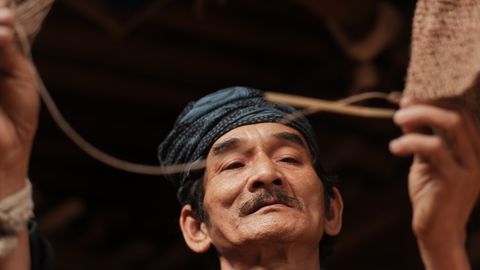
Baskets are the invisible craft. Everyone has one, nobody thinks about it, and the technique is so ordinary that it rarely gets described as a skill.
It is also almost certainly older than pottery, older than weaving cloth, and possibly older than agriculture — the impressions of woven material on early ceramics suggest that basketry informed pottery rather than the other way round.
Why we know so little about the early history
Plant fibre rots. Baskets survive only in exceptional conditions: extremely dry caves, waterlogged anaerobic deposits, or as impressions left in clay and mud.
Which means the archaeological record dramatically under-represents what was probably one of the most important technologies in the human toolkit. A society could have had a sophisticated basketry tradition for millennia and left almost no trace of it.
The main construction methods
Coiling. A continuous bundle of material spiralled around itself and stitched to the previous round. Produces watertight vessels when tightly worked, and is the technique behind some of the most refined basketry in the world. Slow.
Plaiting. Flat strips woven over and under, like cloth. Fast, produces flexible mats and bags, and works with palm leaf, bamboo strip and split cane.
Twining. Two or more flexible elements twisted around a set of rigid uprights. Strong, and it allows patterning through colour changes in the twining elements.
Wicker or stake-and-strand. Rigid uprights with flexible material woven through. The classic willow basket, and the fastest to produce at scale.
Most traditions use several, chosen by what the basket has to do and what grows nearby.
The material decides everything
Basketry is unusually place-specific because the material cannot travel far — it has to be gathered, prepared and worked while fresh or after controlled soaking, and it is bulky and low-value.
Willow in temperate Europe. Rattan and bamboo across Southeast Asia. Palm leaf in the tropics. Grasses, rushes and sedges in wetlands. Split ash and birch bark in northern forests. Roots — spruce, cedar — in the far north and in the Pacific Northwest, producing extraordinarily fine work.
Preparation is the hidden labour. Willow must be cut at the right season, sorted by length, and either used green or dried and resoaked. Ash must be pounded along the growth rings until it separates into splints. Roots must be dug, split and scraped. In most traditions the gathering and preparation take considerably longer than the weaving.
That is one reason basketry declines quietly: the plants require managed access. Willow beds need coppicing, and when nobody cuts them the beds go over. The craft depends on a landscape relationship as much as on a skill.
Baskets that do specific jobs
The variety of specialised forms is the part that repays attention.
Winnowing trays with a specific curvature that lets chaff separate on a toss. Fish traps whose funnel geometry allows entry and prevents exit. Eel traps, lobster pots, crab pots — each shaped by the behaviour of the target species. Carrying baskets with a tumpline for the forehead, which changes how weight sits on the spine. Sieves of graduated coarseness. Baskets woven tightly enough to hold water, and in some traditions used for cooking by dropping in heated stones.
Each of these is a designed object refined over generations, and their forms are not decorative decisions.
Pattern and identity
Because the structure of a basket is visible, the weave itself carries pattern. Colour comes from natural variation in the material, from dyeing, or from selecting the darker inner or lighter outer surface of a split.
In many traditions, specific patterns identify a maker, a family or a community, and in some they carry meanings that are not freely shared. Some designs have restricted use — associated with particular ceremonies or ranks — and reproducing them casually is not neutral.
The current situation
Cheap plastic containers replaced most functional basketry within a generation almost everywhere, for the obvious reasons: they are cheaper, lighter, waterproof and do not need a person to make them.
What survives tends to be one of three things. Ritual or ceremonial forms where the object must be made properly. Highly specialised items where nothing manufactured does the job as well. And work made for a craft market, which pays enough to justify the hours.
The third has kept a great many traditions alive and it changes what is made — larger decorative pieces rather than the everyday forms, and increasingly makers who learned in a workshop rather than at home.
Meanwhile there is a small counter-movement in some places, driven by the environmental case against single-use plastic, toward locally made baskets for shopping and storage. Whether that amounts to anything depends on whether people will pay for hours of skilled labour, which is the same question that has faced every hand craft for two centuries.
Also by Emeka Nwosu
- Mending as a visible actCraft Traditions
- Thatch, mud and stone: building with what is within reachCraft Traditions
- Boats built without plansCraft Traditions
- Making instruments: wood chosen for how it soundsCraft Traditions