Craft Traditions
Red from a root, red from an insect: the dye plants that shaped trade
Before synthetic dyes, a strong, permanent red was one of the most valuable things a textile worker could produce, and the sources for it moved across the world as commodities.
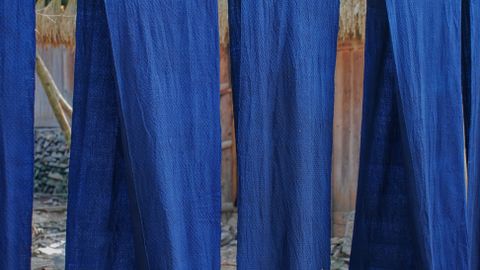
Every dyer's problem is the same: getting colour to stay. Plenty of plants will stain cloth. Very few will produce a colour that survives washing and sunlight, and the ones that do have historically been worth a great deal.
Red was among the hardest and most valuable.
Mordants: the invisible half of the craft
Most natural dyes require a mordant — a metal salt applied to the fibre before or during dyeing, which bonds to both the fibre and the dye and fixes the colour.
Alum has been the most widely used, and access to alum sources was economically significant enough to shape trade and, at points, politics. Iron produces darker, greyer, "saddened" versions of a colour. Tannins from oak galls, pomegranate rind or sumac serve as mordants in their own right and as a pretreatment for cotton, which takes dye far less readily than wool or silk.
The same dye bath over different mordants produces different colours. This is one of the fundamental facts of the craft and one of the reasons a dyer's knowledge is not reducible to a list of plants.
Madder
The root of Rubia tinctorum and related species, cultivated across Europe, the Middle East and South Asia. It yields a range from orange-red through deep brick, depending on mordant, water chemistry and temperature.
Madder is temperature-sensitive in a way that catches out beginners: pushed too hot, the reds turn brown. Traditional processes keep the bath well below boiling and extend the time.
The most celebrated madder process, known by various names associated with Turkey and the Levant, involved a long sequence of treatments including oil, tannin and alum, taking weeks and producing an exceptionally fast, brilliant red. The process was closely guarded and European manufacturers spent considerable effort trying to reproduce it.
Cochineal and the other insect reds
Some of the strongest reds come from insects rather than plants.
Cochineal is a scale insect that lives on prickly pear cactus, cultivated in Mesoamerica long before European contact and producing an intense crimson. After contact it became one of the most valuable exports from the Americas, second in value only to silver in some periods, and its source was kept deliberately obscure for as long as possible.
Kermes, from a different scale insect on oak, served a similar role in the Mediterranean world earlier. Lac, from an insect in South and Southeast Asia, produced reds and also the resin used for shellac.
These insect dyes produce blue-toned reds that madder cannot match, which is why they commanded the price they did.
The yellows, which fade
Yellow is the easiest colour to obtain and the hardest to keep. Dozens of plants yield it — weld, onion skin, turmeric, pomegranate, marigold, various barks — and most fade substantially with light exposure.
Weld is among the more lightfast and was the standard European yellow. Turmeric is brilliant and notoriously fugitive, which is why textiles dyed with it in one era look quite different now.
This matters for anyone looking at historic textiles. Greens were typically made by dyeing yellow over blue, and since the yellow fades faster, a great many surviving "blue" textiles were originally green. Whole colour schemes in museum collections have shifted.
Purple
The famous one. Tyrian purple was extracted from marine molluscs in the eastern Mediterranean, in quantities requiring enormous numbers of animals for a small amount of dye. Its expense made it a marker of rank, formalised in sumptuary rules restricting who could wear it.
Cheaper purples were made by overdyeing red and blue, or from lichens, which produce beautiful colours with poor lightfastness.
What synthetic dyes did
The development of synthetic dyes from the mid-nineteenth century onward collapsed the economics of natural dyeing within decades. Synthetic alizarin replaced madder cultivation almost entirely; synthetic indigo did the same for the indigo trade.
Entire agricultural regions that had grown dye plants for centuries converted to other crops within a generation. It is one of the faster and more complete technological displacements in the history of agriculture, and its social consequences in the growing regions were substantial.
Why it persists
Natural dyeing survives in three forms.
As continuous tradition, in places where hand textile production remained economically viable and where the specific colours are part of what makes the cloth recognisable.
As revival, driven by interest in older processes and by environmental concerns about synthetic dye effluent — though it is worth noting that natural dyeing at scale is not automatically benign, given the mordants involved and the land required to grow dye plants.
And as a craft pursued for its own sake, where the appeal is precisely the parts that make it commercially impractical: the variability, the dependence on a particular water source, and the fact that no two baths are the same.
Also by Emeka Nwosu
- Mending as a visible actCraft Traditions
- Thatch, mud and stone: building with what is within reachCraft Traditions
- Boats built without plansCraft Traditions
- Making instruments: wood chosen for how it soundsCraft Traditions