Craft Traditions
The Loom Sets The Limits Of The Cloth
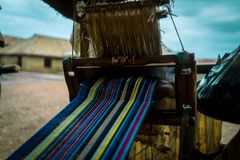
A weaving tradition's patterns, widths and garment shapes are dictated by the machine available, which is why cloth from different regions differs before any decoration is added.
Textile traditions are usually described by their patterns. The more determining factor is the loom, which decides what widths, structures and repeats are physically possible.
Width is decided before anything else
A loom can only produce cloth as wide as the weaver can pass the weft across, and on hand looms that is limited by arm span or by the width of the frame.
Narrow cloth produces garments built from strips joined side by side, and that construction is visible in traditional dress across large parts of the world.
Wide cloth allows a garment cut from a single piece, with the waste that implies. Cutting into cloth is only reasonable where cloth is comparatively cheap and wide.
Portability against complexity
The simplest looms hold the warp with tension from the weaver's own body, which makes them light, cheap and possible to pack up. They suit mobile households and narrow cloth.
Fixed frame looms trade portability for capacity. They can hold longer warps, wider cloth and more mechanisms, but they occupy a room and belong to a settled household or a workshop.
That division tracks a way of life. Pastoral and mobile communities kept the portable loom and developed extraordinary work within its limits rather than moving to a bigger machine.
Pattern is a mechanical question
A weave is created by lifting some warp threads and not others. How many independent groups the loom can lift determines how complex a repeating pattern can be.
Simple looms lift two groups and give plain cloth, and adding more allows twills and diamonds. Elaborate patterned traditions all rest on a mechanism for controlling many groups at once.
Where the loom could not produce the pattern, it was added afterwards by hand, which is why embroidery and printing flourish in some regions and are almost absent in others.
The second worker in patterned weaving
The most complex hand-woven patterns historically needed two people, one weaving and one operating the pattern mechanism from above or beside the loom.
That doubled the labour cost and put the finest cloth firmly in the luxury category. It also created an apprenticeship, since the assistant's role was how a young weaver learned.
Mechanising that second role was the change that let complex patterned cloth be produced by one operator. The pattern possibilities barely changed, but the price collapsed.
Why old cloth widths persist
Traditional garments often retain the proportions of a loom nobody uses any more. Seams sit where two narrow strips were joined, even when the cloth now arrives in a single wide piece.
Borders and selvedge decoration persist for the same reason. They were placed at the edge because the edge was where the loom put it, and they remain there as ornament.
Reading a garment for those traces tells you what machine made the original. The loom leaves its dimensions in the clothing long after the loom itself is gone.
Also by Emeka Nwosu
- Mending as a visible actCraft Traditions
- Thatch, mud and stone: building with what is within reachCraft Traditions
- Boats built without plansCraft Traditions
- Making instruments: wood chosen for how it soundsCraft Traditions