Craft Traditions
The indigo vat is alive, and that is the whole difficulty
Fermentation indigo dyeing is not a recipe so much as a relationship with a population of bacteria that has to be fed, warmed and kept slightly hungry.
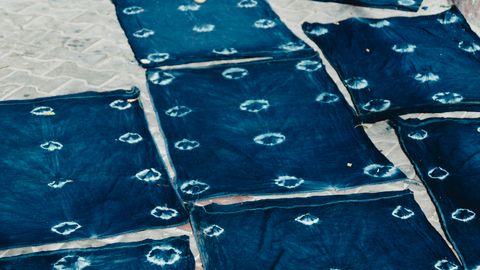
Blue is the difficult colour. Reds and yellows can be extracted from plants by boiling; a great many of them will bond to cloth with the help of a metal salt and a hot bath. Indigo will not. The pigment is not soluble in water, and a pot of blue powder and hot water will simply produce a pot of blue powder and hot water.
What makes indigo dyeing possible is a chemical reduction. Strip oxygen out of the molecule and it becomes a soluble yellow-green form that cloth will absorb. Lift the cloth into the air, oxygen returns, and the colour develops in front of you — green, then teal, then blue, over about half a minute. Dyers never tire of watching this and neither does anyone who sees it for the first time.
The question is how you get the oxygen out.
Chemistry or bacteria
Industrial dyeing does it with a chemical reducing agent, usually sodium hydrosulphite. It is fast, reliable and controllable, and it produces a great deal of the world's denim.
The older method uses fermentation. You build a vat containing indigo, an alkaline source, and something for microorganisms to eat — bran, madder root, dates, fruit, henna, depending on where you are. Bacteria consume the sugars, the oxygen in the vat is used up, and the indigo is reduced biologically.
The result is a living system. It has a temperature it prefers, usually somewhere warm. It needs feeding. It goes off if neglected. It smells — the descriptions range from "sweet" to "a barn" depending on the vat and the honesty of the describer — and experienced dyers use that smell as a diagnostic.
Reading a vat
A healthy fermentation vat announces itself visually. A coppery, iridescent film forms on the surface — the flower, as it is often called. Underneath, the liquid is a yellow-green. Bubbles gather. Dip a stick and the liquid that comes up should be that greenish colour, turning blue where it meets the air.
If the liquid is blue rather than green, the reduction has failed and the vat needs feeding or warming. If it is thin and sour, the balance has tipped too acidic. If nothing is happening at all, it is probably too cold.
None of this is measured with instruments in most workshops. It is read by eye and nose, and it is the kind of knowledge that takes a season to acquire and cannot really be written down, which is why apprenticeship persists in dyeing long after it has disappeared from other trades.
Where the traditions run deep
Indigo-bearing plants grow across much of the world, and dyeing traditions developed independently in many of them. The species differ — Indigofera in India and West Africa, woad in Europe, Persicaria tinctoria in Japan, and others elsewhere — but the chemistry is the same molecule.
In Japan, the fermentation process involves composting the leaves into a material called sukumo over months before the vat is even built, and the resulting depth of blue has a vocabulary of its own for different shades. In West Africa, resist-dyed cloths made with cassava paste or stitched resists produce patterns that are recognisable at a distance and specific to particular communities. In parts of India, the trade was substantial enough to shape colonial economics and, eventually, rebellion.
What is striking is not the differences but the convergence. Independently, across continents, people worked out that if you rot the right leaves in the right alkaline liquid, you get blue.
The colour builds in layers
One dip gives pale blue. Deep indigo requires many — sometimes dozens — each followed by full oxidation in the air before the next. The colour accumulates on the surface of the fibre rather than penetrating fully, which is why indigo fades the way it does, wearing away at the points of friction and producing the specific ageing pattern that denim is prized for.
That surface behaviour is also why indigo crocks — rubs off — when new, and why cloth is washed and beaten after dyeing to remove what has not bonded.
Why anyone still does it this way
Synthetic reduction is easier and the resulting blue is chemically identical. The argument for fermentation is partly environmental — a fermentation vat can be maintained for years and eventually composted, whereas hydrosulphite baths produce waste requiring treatment — and partly about the cloth itself, where dyers argue that the slower process produces a different hand and depth.
But talk to people who keep vats and the real reason emerges more slowly. The vat is a thing you look after. It responds to attention. It rewards a kind of daily noticing that most manufacturing has designed out.
One dyer described it as being closer to keeping bread than to making anything. You feed it, you keep it warm, you use it, and if you go away for a month without arranging for someone to look after it, you come back to a dead one and start again.
Also by Emeka Nwosu
- Mending as a visible actCraft Traditions
- Thatch, mud and stone: building with what is within reachCraft Traditions
- Boats built without plansCraft Traditions
- Making instruments: wood chosen for how it soundsCraft Traditions