Craft Traditions
The wheel and the coil: two entirely different ways to make a pot
Throwing on a wheel is the image everyone has of pottery. Most of the world’s ceramic traditions were built without one, and the difference goes beyond technique.
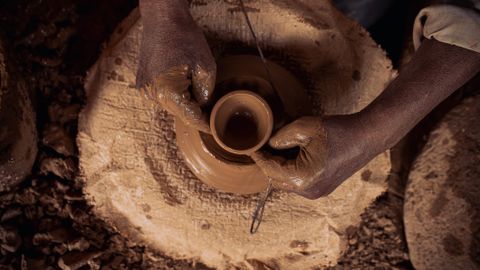
Ask anyone to picture pottery and you get a wheel: a spinning disc, wet hands, a cylinder rising. It is a genuinely remarkable technology and it is not the only one, nor the oldest, nor the most widespread across the history of the craft.
Hand-building came first and never stopped
The main hand-building methods are pinching, coiling and slab construction.
Pinching starts with a ball of clay, a thumb pressed into the centre, and the walls drawn up between thumb and fingers as the piece rotates in the hand. Small vessels, and the first technique nearly everyone learns.
Coiling builds walls from ropes of clay laid in rings and welded together, then scraped, paddled and smoothed until the joins vanish. It has no size limit in the way a wheel does, and enormous storage vessels across many traditions are coiled.
Slab construction uses flat sheets cut and joined, which suits angular forms that a wheel cannot produce at all.
These are not primitive precursors. Coiling is used today by potters who could throw perfectly well, because it does things throwing cannot.
What the wheel actually changed
Speed and repeatability, primarily. A skilled thrower can produce dozens of near-identical vessels in the time coiling one takes.
That matters when pottery is a commercial product — when a workshop supplies a city, or when standard measures are required for trade. The spread of wheel-thrown pottery in the archaeological record tends to track the emergence of specialised craft production and urban markets rather than simply the availability of the technology.
The wheel also imposes constraints. Everything thrown is radially symmetrical. Size is limited by what one person can control in a single mass of clay. And it requires clay with particular plastic properties — not every local clay throws well, though most will coil.
Why many traditions did not adopt it
Sometimes it was unknown. Often it was known and not adopted, which is more interesting.
In much of sub-Saharan Africa, pottery has been predominantly hand-built, frequently by women, within household or community production rather than specialised workshops. Vessels are made to a specification the maker knows and the community expects, and the volumes involved do not reward mechanisation.
Many Indigenous American traditions produced ceramics of extraordinary refinement entirely without a wheel. Some of the finest thin-walled, burnished vessels in the world are coiled.
The pattern suggests that the wheel arrives where pottery becomes a specialised trade producing for a market, and that where it stays a household craft, hand-building persists because it fits.
Firing, which decides more than forming
The forming method gets the attention and the firing determines what the pot actually is.
Open or pit firing — vessels stacked with fuel and burned, reaching relatively low temperatures for a short time. Produces porous, comparatively fragile earthenware, often with beautiful flashing and smoke marks. Requires no permanent structure and it is how most pottery in human history was fired.
Updraught and downdraught kilns reach higher temperatures and hold them, allowing denser, stronger bodies and reliable glazes.
Climbing kilns built up a slope, used across East Asia, allow very high temperatures and long firings, and produce the stoneware and porcelain traditions those regions are known for.
Porosity is not simply a defect. A porous water jar allows slow evaporation through the wall, which cools the contents — a genuine functional advantage in hot climates, and a reason low-fired vessels persisted where high-fired ones were available.
The clay decides a great deal
Traditional potters used local clay, and local clay varies enormously in plasticity, iron content, shrinkage and firing temperature.
Much of what distinguishes regional traditions comes from this. The characteristic colour of a ware is usually iron in the clay body. The forms suit what the clay will hold. Tempering materials added to reduce cracking — sand, crushed shell, grog, dung, plant fibre — differ by what was available and leave signatures that archaeologists use to trace trade.
Why this matters now
Ceramic traditions are under pressure everywhere from cheap manufactured containers. Plastic and aluminium do most of what a household pot did, more cheaply and without breaking.
What survives tends to survive for one of three reasons: a function the alternatives do not serve, such as evaporative cooling or a specific cooking property; a ritual role where the vessel must be made a particular way; or a market for the object as craft.
The third keeps a lot of workshops open and it changes what is made — toward decorative pieces and away from the everyday forms that were the tradition's actual content. That is not nothing, and it is worth being clear-eyed that a tradition preserved as craft is a different thing from one preserved as use.
Also by Emeka Nwosu
- Mending as a visible actCraft Traditions
- Thatch, mud and stone: building with what is within reachCraft Traditions
- Boats built without plansCraft Traditions
- Making instruments: wood chosen for how it soundsCraft Traditions