Food Cultures
Rice terraces are infrastructure, and they need people
A terraced hillside is a water management system built over centuries, and it collapses within a decade or two if the community maintaining it leaves.
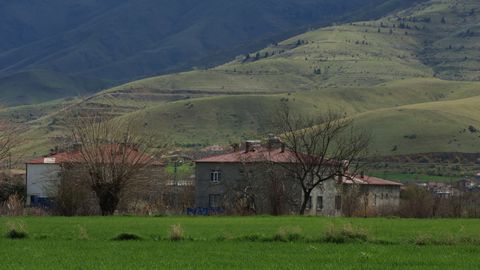
Terraced rice cultivation appears across monsoon Asia — the Philippines, Indonesia, Vietnam, southern China, Nepal, Japan — and in each case represents an accumulated investment of labour that is difficult to overstate.
The terraces are not fields cut into a hill. They are a hydraulic system.
What a terrace actually does
Wet rice requires standing water at controlled depths at particular stages of growth, and the depth needs to change over the season. On a slope, that requires each terrace to be level, to hold water, and to pass surplus water to the terrace below at a controlled rate.
So the system involves: level platforms, retaining walls in stone or packed earth, a puddled impermeable layer in the paddy floor, inlets and outlets for each terrace, and channels carrying water from a source — usually a spring or a stream high on the slope — across the hillside to the top of the system.
The water then descends through the whole terraced sequence, and every terrace's supply depends on the operation of the ones above it.
Which makes it a social system
This is the crucial point. No individual can manage a terrace independently, because their water comes through someone else's field.
The result is that terraced landscapes are always accompanied by institutions for allocating water, scheduling planting, mobilising labour for maintenance, and resolving disputes.
The Balinese subak system is the most studied example: an association of farmers sharing a water source, with a rotation determining who irrigates when, and with a ritual calendar that coordinates planting across a whole watershed. Research has argued that this coordination has real agronomic function, synchronising fallow periods across large areas in a way that suppresses pests.
Similar institutions, under different names, appear wherever terraced irrigation exists. They are among the most-cited examples in the literature on how communities manage shared resources without either private ownership or central control.
The maintenance burden
Terraces degrade constantly. Retaining walls slump. Channels silt up. Rodents burrow through bunds. Heavy rain damages the system somewhere every year.
Maintenance is continuous and it is labour-intensive, and much of it requires collective effort — a single farmer cannot repair a channel that serves twenty households.
Which means the system persists only while there are enough people, and while the institutions that mobilise them still function.
What happens when people leave
The pattern is documented in several terraced regions and it is consistent.
Young people leave for urban work. Remaining farmers age. Fewer hands are available for collective maintenance. Some terraces are abandoned.
An abandoned terrace is not a neutral event for its neighbours. Water that is no longer managed goes somewhere. Walls that are not repaired collapse and take the terrace below with them. Vegetation changes the water regime. Failure propagates downhill.
Estimates of abandonment in some terraced regions are substantial, and the visible consequences — collapsed walls, gullying, landslides — appear within years rather than decades.
The recognition problem
Several terraced landscapes have been designated as heritage sites of international significance, which brings tourism, funding and attention.
It also creates a tension. The terraces exist because they were farmed. Preserving them as landscape while the farming becomes economically unviable produces a situation where the maintenance is funded as heritage work rather than performed as agriculture — which may keep the walls standing and does not keep the system alive in the sense that mattered.
Some programmes have addressed this directly by subsidising farming rather than restoration, or by developing markets for the specific rice varieties grown in these systems, which are frequently traditional cultivars with characteristics that command a premium.
The knowledge that goes with it
Terrace agriculture involves a body of detailed local knowledge: which varieties suit which elevation, when to open a particular channel, how to read the timing of the monsoon, how to repair a specific type of wall.
This knowledge is held by practitioners and transmitted by working alongside them. It does not survive a generation gap. A community that stops farming for twenty years and then wants to resume finds that the people who knew how are no longer able to teach it.
That is the deeper loss, and it is the one that determines whether abandonment is reversible.
Why it matters beyond the region
Terraced systems demonstrate something that is otherwise hard to show: that intensive agriculture on difficult terrain can be sustained for many centuries without degrading the soil, given the right institutions.
The technical elements are interesting. The institutional elements are arguably more so, because the technical problem of moving water downhill is solvable and the problem of getting several hundred households to cooperate reliably for six hundred years is the one that usually defeats people.
Also by Emeka Nwosu
- Mending as a visible actCraft Traditions
- Thatch, mud and stone: building with what is within reachCraft Traditions
- Boats built without plansCraft Traditions
- Making instruments: wood chosen for how it soundsCraft Traditions